Collection of Vietnamese Edicts and Official Documents
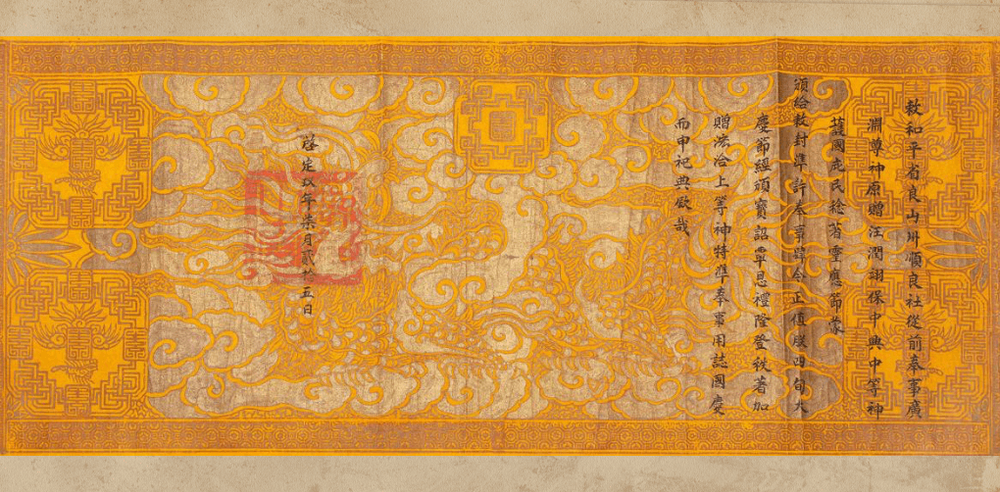
Spanning several centuries of Vietnamese history, the Collection of Vietnamese Edicts and Official Documents at Penn State University offers a rare window into the workings of the imperial state, the relationship between political and spiritual authority, and the documentary culture of premodern Vietnam.
Held by the Eberly Family Special Collections Library at Pennsylvania State University, the collection comprises 32 imperial edicts and high-level bureaucratic documents dating from the Lê (1428–1789) and Nguyễn (1802–1945) dynasties. The documents are handwritten in Chinese characters (chữ Nho), the script historically used for scholarship and official administration in Vietnam.
Imperial Authority in Written Form
Among the collection's most visually striking objects are imperial edicts (sắc phong). Far more than administrative records, these documents embodied the authority of the emperor and connected the imperial court with religious and communal life throughout the country.
Some edicts record the conferral or enhancement of titles upon deities. Through such acts, Vietnamese emperors incorporated local gods into an officially recognized spiritual hierarchy. The documents therefore reveal an important dimension of Vietnamese kingship: imperial sovereignty extended not only over officials, territories, and human subjects, but also symbolically over the spiritual powers associated with the land.
An edict issued in 1821, the second year of the reign of Emperor Minh Mạng, for example, grants three additional honorific characters to the title of a deity. Written on yellow paper, the document is decorated with a dragon and phoenix in silver ink and a dark-ink cloud motif. Its elaborate material form demonstrates how writing, visual symbolism, ritual, and political authority could converge in a single document.
Documents of Government and Everyday Administration
Alongside the decorated imperial edicts are more restrained bureaucratic documents that illuminate the administrative machinery of the Nguyễn state.
Documents dating from Minh Mạng 19 (1838) through Bảo Đại 19 (1944) include promotions, petitions, commands, and official communications. Many were produced on plain white paper rather than the richly decorated materials associated with imperial edicts. Together, they provide evidence of how government operated through written exchanges among rulers, officials, and administrative institutions.
Their chronological range is particularly significant. The later documents extend into the period of French colonial rule, when the Nguyễn monarchy continued to exist while its political authority was profoundly transformed. The collection thus allows researchers to trace aspects of Vietnamese bureaucratic practice across major political transitions—from an independent imperial state to the complex administrative landscape of colonial Vietnam.
A Heritage of Chữ Nho
The collection is also valuable as a record of Vietnam's historical writing culture. All 32 documents are handwritten in Chinese characters, or chữ Nho. For centuries, Literary Chinese and chữ Nho occupied a central position in Vietnamese government, scholarship, diplomacy, ritual, and elite intellectual life.
By the twentieth century, however, this documentary culture was rapidly disappearing as the Romanized Vietnamese script, quốc ngữ, became dominant. Penn State specifically identifies the use of Chinese characters as an important feature of the collection because the practice has largely become obsolete in contemporary Vietnamese society.
For today's researchers, these documents therefore preserve more than their textual contents. Their calligraphy, formats, papers, decorations, dates, titles, and administrative conventions provide material evidence for understanding how knowledge and authority were recorded and transmitted in Vietnam.
From the Archive to the Digital Collection
The physical collection is preserved at Penn State's Eberly Family Special Collections Library. A digital version makes images and descriptive information available online. Penn State notes that the digital collection currently consists of dealer images showing the fronts of the scrolls, while the physical holdings comprise the complete set of 32 documents.
Individual digital records can provide remarkably detailed information. The 1821 Minh Mạng edict, for instance, is accompanied by its Gregorian and Vietnamese dates, physical description, script and language information, and a transcription of its text. Such metadata makes the collection useful not only for historians but also for scholars interested in Hán-Nôm studies, religious history, manuscript studies, calligraphy, material culture, and digital humanities.
The collection also belongs to a much larger landscape of Vietnamese documentary heritage. Comparable bodies of Sino-Nôm materials preserved in Vietnam demonstrate the importance of royal edicts and administrative records for reconstructing local histories, education, religious practices, political institutions, and the relationship between communities and the state. UNESCO's Memory of the World Committee for Asia and the Pacific, for example, has highlighted these dimensions in its recognition of collections of Sino-Nôm documents from Vietnam.
Reading Vietnam Through Its Documents
Viewed individually, an edict might record the elevation of a deity's title, while a bureaucratic communication might document an appointment, petition, or government instruction. Viewed together, however, the collection opens onto a much broader history.
These documents show a state operating through writing: naming and ranking gods, appointing officials, transmitting orders, responding to petitions, and maintaining administrative relationships across space and time. At the same time, their changing forms and historical contexts allow us to observe transformations in Vietnamese political and documentary culture across the Lê and Nguyễn dynasties and into the colonial twentieth century.
The Collection of Vietnamese Edicts and Official Documents thus provides an important point of entry into the study of Vietnam's imperial past—not simply through narratives written retrospectively, but through documents that once participated directly in the exercise of authority itself.
Explore the collection through the Penn State University Libraries collection page.
Also available on the Digitizing Vietnam Platform: Vietnamese Edicts and Official Documents